
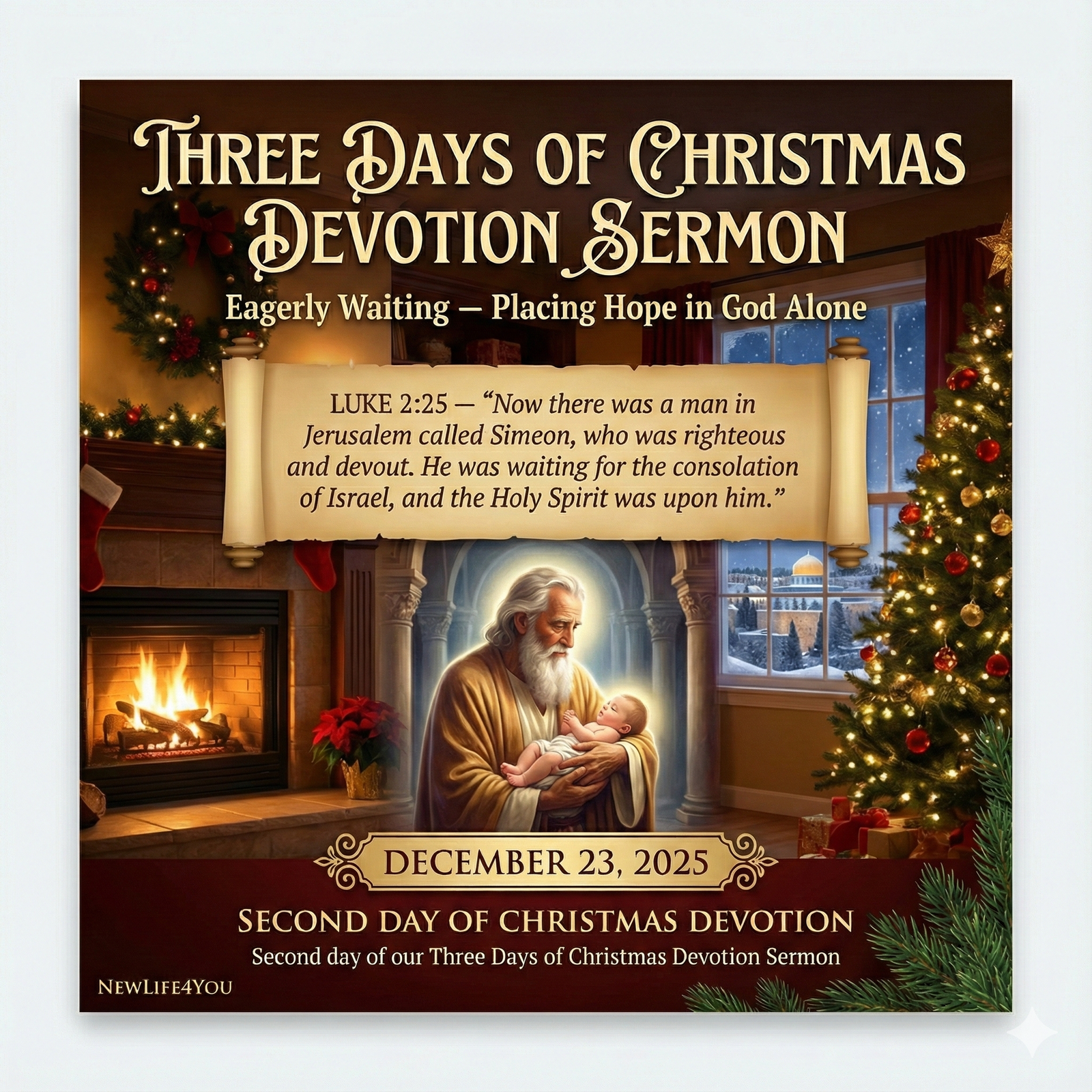
Christmas Devotion: Put Your Hope in the Right Place
Bible Verse: Luke 2:25 — “Now there was a man in Jerusalem called Simeon, who was righteous and devout. He was waiting for the consolation of Israel, and the Holy Spirit was upon him.”
Theme: Eagerly waiting– Placing Hope in God Alone
Date: December 23, 2025
Introduction: The Second Day of a Three-Day Christmas Devotion
Today is the second day of our Three Days of Christmas Devotion. Yesterday we reflected on Simeon’s example of Eagerly Waiting — trusting that God always honours those who wait in faith.
Now, on this second day, we move deeper into that waiting and consider an important truth: where we place our hope during the waiting determines how we endure it.
Many people today put their hope in the wrong places. They trust in wealth, careers, relationships, or their own achievements. None of these are inherently bad, yet none can be a foundation strong enough to hold the weight of your life.
The psalmist declares plainly:
“Do not put your trust in princes, in human beings, who cannot save. When their spirit departs, they return to the ground; on that very day their plans come to nothing.” (Psalm 146:3–4)
But he also points us to something greater:
“Blessed are those whose help is the God of Jacob, whose hope is in the LORD their God.” (Psalm 146:5)
This is the heart of today’s reflection: to put your hope in the right place — in God Himself, the one true source of lasting hope and peace.
- Simeon’s Hope During the Waiting
Simeon’s entire life was defined by hope. “He was waiting for the consolation of Israel.” This consolation referred to God’s promised deliverance — the coming of the Messiah. Even after centuries of prophetic silence, Simeon’s faith did not fade. He waited not because his life was easy but because his heart was anchored in God’s promises. The Holy Spirit rested upon him and gave him assurance that he would not die until he saw the Christ. Hope like this can only exist when it’s grounded in the right foundation. The strength of your hope depends on the strength of what you’re hoping in.
When you place your hope in circumstances, disappointment is inevitable. When you place your hope in people, even those you love, you risk heartbreak. But when you anchor your hope in the eternal promises of God — your hope holds firm, no matter the storm.
Just as Simeon held on in the silence, you too can hold on in seasons of waiting, because God’s Word is unchanging. His promises never expire.
- The Wrong Places to Put Our Hope
Psalm 146 warns against misplaced hope. “Do not put your trust in princes,” the psalmist says — meaning don’t anchor your confidence in earthly powers or fleeting things.
Modern life offers many false foundations:
- Wealth, which gives comfort but not peace.
- Career success, which can fade overnight.
- Relationships or popularity, which can shift with time.
- Status or recognition, which depend on opinion rather than truth.
These can all be blessings, but they were never meant to be the source of our security. They are gifts, not gods. When we build our hope on temporary things, life becomes fragile. A sudden change can take away what we trusted most, leaving us adrift. But Simeon teaches us to look beyond the visible — to hope in the unseen faithfulness of God. He placed his hope not in Rome’s rule, not in religion’s routines, but in the living God who keeps His promises. That’s why, when the promise appeared as a small infant in Mary’s arms, his heart instantly knew: This is the One I’ve been waiting for.
- The Right Place to Put Our Hope
Psalm 146:5 continues, “Blessed are those whose help is the God of Jacob, whose hope is in the LORD their God.” This hope is steady because the One we hope in is steady. Verse 6 reminds us that God is “the Maker of heaven and earth, the sea, and everything in them — He remains faithful forever.” While human promises are fragile and fleeting, God’s promises are eternal. He not only gives hope; He is our hope. When Scripture calls Him “faithful forever,” it means that His character will never betray the trust we place in Him.
- The God Who Gives Hope to the Hopeless (Psalm 146:7–9)
The psalmist shows us that God’s heart leans toward those who seem to have no hope at all. He lists them: the oppressed, the hungry, the prisoners, the blind, the marginalised, and the bereaved.
Each group reveals a form of pain that still exists today — and a promise that God still sees, cares, and acts.
The Oppressed
God gives justice and freedom to those who are treated unfairly or weighed down by life’s heavy burdens. The Lord is not distant from your struggle; He is your defender. When the world silences your pain, He hears your cry. Christ was born to set the oppressed free — and He still does.
The Hungry
To the hungry, God provides food for the body and nourishment for the soul. He is the Bread of Life, feeding both the stomach and the spirit. If you feel empty this Christmas, Jesus comes to fill you — to satisfy you with purpose, grace, and love that will never run out.
The Prisoners
For those bound by chains — whether physical, emotional, or spiritual — God brings release. Jesus came to proclaim liberty to the captives. There is no addiction or regret that His mercy cannot break. Even locked doors open when the Lord says, “Be free.”
The Blind
To the blind, God restores sight — opening physical eyes and spiritual ones. His light dispels every darkness and gives new vision. When you cannot see what God is doing, trust that He is still at work. He will guide your steps until your eyes behold His goodness.
The Marginalised
To the stranger, the outcast, the forgotten, God extends belonging. Jesus was born not in a palace but in a humble stable, reminding us that all are welcome in His presence. If you’ve felt unseen or unwelcome, Christmas declares: You are loved. You belong.
The Bereaved
To the bereaved, God offers comfort that reaches deeper than grief. He is near to the broken-hearted and binds up their wounds. The tears you shed are seen and cherished. Because of Jesus — who conquered the grave — death no longer has the final word. The One born in Bethlehem came to promise eternal reunion and everlasting peace.
In every one of these needs, God is not distant — He draws near. He gives hope to those the world tends to overlook. Christmas reveals this truth perfectly: He came for the hurting, the humble, and the hopeless — to show that His love reaches every human heart.
- Hope as the Anchor of the Soul
Hebrews 6:19 describes hope in God as “an anchor for the soul, firm and secure.” Anchors don’t stop the storms — they keep the ship from drifting. In the same way, hope in Christ doesn’t remove life’s challenges, but it keeps us steady through them. Simeon’s hope did just that. When he finally saw the infant Christ, he said with peace, “Sovereign Lord, now let Your servant depart in peace, for my eyes have seen Your salvation.” The promise of God brings peace to all who wait and trust. No matter how long the wait, no matter how deep the sorrow, God will keep His word. Hope that is anchored in Him will never fail.
- Living Hope in a Hopeless World
The God of hope not only sustains us — He calls us to share that hope. Psalm 146 reminds us that hope is for the oppressed, the hungry, and the hurting. As followers of Christ, we become His hands to lift, feed, and comfort. When you anchor your hope in God, you carry the light of Christmas into dark places. Hope-filled people bring healing to hopeless spaces — just as Simeon’s faith inspired others that day in the temple. This is Christmas in action: receiving hope and then reflecting it to others.
Conclusion: Where Is Your Hope Today?
On this second day of Christmas Devotion day, ask yourself: where is your hope anchored? If your hope has rested on fragile things, lift it higher — to the Maker of heaven and earth, who remains faithful forever. In Christ, hope stands firm. In Him, every promise finds its “Yes.” Christmas declares that God has come near, and in His presence, no life is beyond renewal. So, let your heart echo Simeon’s prayer this Christmas: “My eyes have seen Your salvation.” For when you put your hope in the right place — in God alone — you will never be disappointed.
Prayer:
Gracious Father, thank You for being the God of hope — the One who lifts the oppressed, feeds the hungry, frees the captive, gives sight to the blind, welcomes the outcast, and comforts the brokenhearted. Teach us to put our hope in You alone. Anchor our hearts in Your faithfulness, and help us to share Your hope with a world in need. In Jesus’ name, Amen.
God bless you all.