
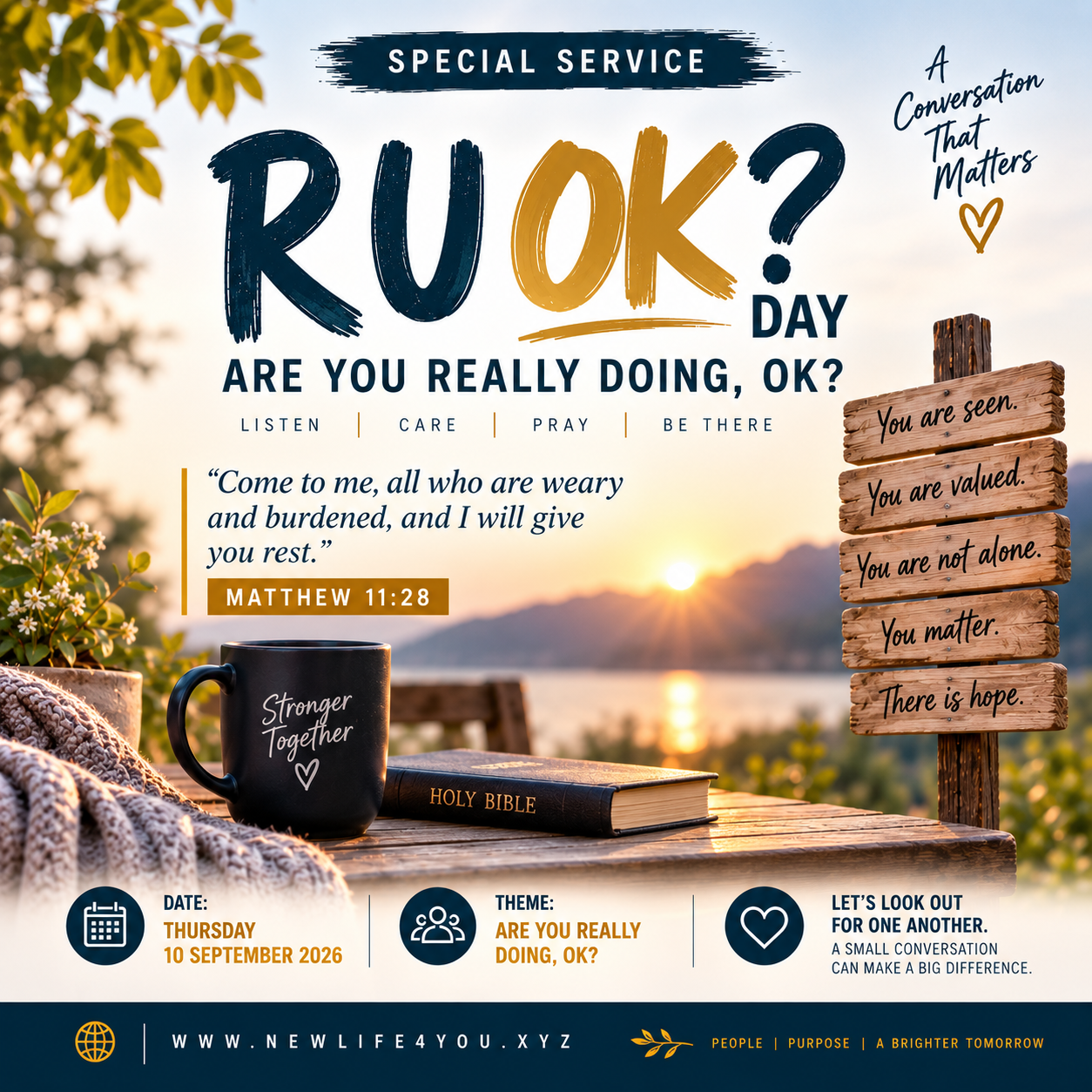
Special Service: R U OK? Day
Theme: “Are You Really Doing, OK?”
Scripture Reading: Matthew 11:28 : “Come to me, all you who are weary and burdened, and I will give you rest.”
Galatians 6:2 : “Carry each other’s burdens, and in this way you will fulfill the law of Christ.”
Service Introduction
Beloved brothers and sisters, welcome to the house of God. Today is Thursday, September 10, 2026. Across our nation and throughout our communities, this date marks a deeply significant occasion: R U OK? Day.
It is a day that urges us to stop running, turn to our neighbour, look past the polite smiles, and ask a question that has the power to rescue a soul from sinking: “Are you OK?”
We walk into this sanctuary carrying our Bibles, wearing our clean clothes, and offering warm handshakes. We know the right words to say. We know how to smile when our name is called. But beneath the surface, behind the eyes of people sitting right next to us in these pews, a quiet battle is being fought.
Many of us wake up in the morning already exhausted. We look at our calendars, our responsibilities, our families, and our work, and our chests feel tight. We scroll through phones filled with bright pictures of other people’s achievements, wondering why everyone else seems to be sailing smoothly across calm waters while our little boat is taking on waves. We say the words, “I’m doing fine, thank you,” because we don’t want to cause a fuss. We don’t want to be a burden. We are terrified that if we speak the raw, unvarnished truth, people will see us as weak, lacking in faith, or unable to carry our share of the load.
Today, this sanctuary is a sanctuary in the truest sense of the word: a safe haven. You do not have to perform here today. You do not have to pretend that your marriage is effortless, that your finances are perfect, that your mental health is untouched by anxiety, or that your heart is not breaking.
Our guiding scripture today comes directly from the gentle lips of Jesus Christ in Matthew 11:28:
“Come to me, all you who are weary and burdened, and I will give you rest.”
Notice what the Lord does not say. He does not say, “Come to me, all you who have figured everything out.” He does not say, “Come to me, all you who are cheerful, productive, and victorious.” He looks past the crowd of religious leaders, past the successful merchants, past the proud, and He speaks directly to the brokenhearted, the bone-tired, and the silently overwhelmed. He calls out to the weary.
If you arrived here today running on pure fumes, this service is God’s personal appointment with your spirit. Today we ask the question honestly, without fear, without judgment: Are you really doing OK?
- The Heavy Armor of “I’m Fine”
We live in a world that rewards strength and penalises vulnerability. From the time we are children, we are taught to wipe our tears quickly, get back on our feet, and keep moving. As adults, this instinct hardens into a thick wall of emotional defense. We learn to wear “I’m fine” like a suit of heavy armor.
Think about how many times this week alone you have spoken those two words. Someone in the hallway asked how your week was going, and before your brain could even process the sleepless nights or the knot in your stomach, the armor snapped shut: “I’m fine.”
Armor is designed to protect a soldier from spears and arrows. In the short term, our emotional armor protects us from awkward conversations and unwelcome pity. But there is a tragedy inherent to heavy armor: while it keeps the blows out, it also traps the pain inside, and it prevents anyone from reaching in to embrace you.
Carrying this armor every single day is draining the life out of you. You are carrying the weight of your family’s expectations. You are holding together projects that feel like they are coming apart at the seams. You are managing health scares, caring for ageing parents, walking with troubled youth, or managing financial pressures that keep you staring at the bedroom ceiling at two o’clock in the morning.
Yet when you step out into public, you strap that heavy iron plate back onto your chest. You smile, you nod, you ask about everyone else’s well-being, and you carry on.
God never designed your soul to function as an impenetrable fortress. When we look at Scripture, David did not hide his weeping; he soaked his couch with tears in Psalm 6. Elijah, after great victories, sat under a broom tree in 1 Kings 19, utterly depleted, and told God he could not go on. Jeremiah wept openly for the destruction of his people. Even Jesus, in the Garden of Gethsemane, looked at Peter, James, and John and said plainly in Matthew 26:38, “My soul is overwhelmed with sorrow to the point of death.”
If the Son of God was willing to admit that His soul was crushed with sorrow, why do we treat our suffering like a shameful secret?
Drop the armor today. You are among family. Admitting that you are hurting does not mean you have failed God; it simply means you are human, and human beings need grace, rest, and one another.
- Burnout Is an Alarm, Not a Sin
There is a terrible lie circulating in modern culture—and even inside modern churches—that equates exhaustion with laziness or spiritual deficiency. When an individual reaches the end of their rope and can no longer find the energy to complete basic tasks, the enemy whispers into their ear: “You are just lazy. Look at everyone else. If you prayed more, if you fasted more, if you managed your time better, you wouldn’t be failing like this.”
Let this truth shatter that lie right now: You are not lazy; you are burned out. And there is a world of difference between the two.
- Laziness is having the strength to do what is right and choosing not to care.
- Burnout is caring so fiercely, giving so deeply, and carrying the burdens of others for so long that your physical and emotional reserves have completely emptied.
Burnout does not happen because you are weak; it happens because you tried to be strong for too long without stopping to refill the well. It creeps in slowly. At first, it is simply normal tiredness that you believe a good weekend sleep will fix. But then the tiredness becomes permanent. It settles into your bones. You sleep eight hours, but you wake up feeling as though you haven’t slept in a week.
Then comes the numbness. You find yourself detached from the things you once loved. The work that used to give you joy feels like a mountain you are forced to climb every morning. Worst of all, the people you love—your spouse, your children, your friends, the people you serve in your community—begin to feel like demands on a bank account that has been overdrawn for months. You begin to feel irritated by their simplest requests, and then you feel drowning waves of guilt for feeling irritated.
Listen carefully: Burnout is not a spiritual failure; it is a physical and emotional smoke alarm.
When the smoke alarm sounds in your house, you do not get angry at the alarm. You do not hit the alarm with a stick and call it unfaithful. The alarm is simply doing its job—it is warning you that there is a fire in the building that needs your immediate attention.
Your exhaustion, your tears, your headaches, your inability to focus—these are the alarms of your soul. Your body is raising a white flag, saying: “Something has to change. We cannot keep running on empty.”
God respects our physical limits. When Elijah collapsed in the wilderness, wishing for his life to end, God did not send a thunderstorm of rebuke. God did not preach a sermon to Elijah about having more faith. What did God do? First Kings 19 tells us that God sent an angel with warm bread baked over coals and a jar of fresh water. God let Elijah sleep, fed him again, and let him rest some more.
Before God ever spoke to Elijah’s calling, He cared for Elijah’s body. God knows how you are formed; Psalm 103:14 reminds us that He remembers that we are dust. Do not despise your limits. Acknowledge them, and let them lead you back to rest.
- The Sacred Art of Setting the Load Down
Let us return to the words of Christ in Matthew 11:28:
“Come to me, all you who are weary and burdened, and I will give you rest.”
In the original context of this passage, Jesus was speaking to people who were crushed under the legalistic burdens imposed by the Pharisees. The religious leaders had created hundreds of intricate rules and regulations, piling them onto the backs of ordinary people like heavy sacks of grain, but doing nothing to help them carry the weight.
Today, our burdens look slightly different, but the weight is identical. We carry the burden of people-pleasing, saying “yes” to every request because we are terrified of letting someone down. We carry the burden of financial survival, running from job to job, shift to shift, trying to stay ahead of rising costs. We carry the burden of perfection, believing that if we let a single plate drop, our whole world will shatter.
Jesus looks at your overloaded life and offers a divine exchange. He says: “Come to me.”
Notice that rest is not found in an ideal vacation, a promotion, or a cleared inbox. Rest is found in a Person.
Jesus does not say, “Go fix all your problems, tidy up your schedule, and then come see me.” He says, “Come while you are weary. Come while you are burdened.”
To set the load down requires a deliberate, intentional act of surrender. It means opening your hands and letting go of the things you were never meant to control. You are not responsible for saving every person you meet. You are not responsible for controlling the future. You are not God.
Genesis 2:2 tells us that on the seventh day, God rested from all His work. Did the Almighty rest because His divine power was drained? Did the Creator of the universe feel faint from speaking galaxies into existence? Absolutely not. God rested to demonstrate a holy rhythm for creation. He rested to show us that stepping back, breathing, and stopping our striving is holy.
If God paused His work, what makes you think you can work seven days a week, fourteen hours a day, without stopping?
Rest is not an indulgence you earn after finishing every chore on earth. Rest is a non-negotiable spiritual requirement for finishing the race. When you rest, you make a declaration of faith: “Lord, the world belongs to You, not to me. You can sustain my family, my job, and my church while I close my eyes and sleep.”
- Becoming a Safe Harbour for the Hurting
This service is called “Are You Really Doing OK?” because this message has two sides. The first side is learning to be honest about our own exhaustion. The second side is learning how to truly see the exhaustion in the brothers and sisters walking beside us.
We live in a culture of immense speed and devastating isolation. We can sit in a crowded room, work in a busy office, or even attend a packed Sunday service, and still feel completely and totally invisible. We walk past people whose hearts are bleeding out in silence, but because we are in such a hurry to get to our next task, we never stop long enough to notice the trembling hands or the sadness behind their eyes.
Galatians 6:2 instructs the church:
“Carry each other’s burdens, and in this way you will fulfill the law of Christ.”
How do we carry one another’s burdens? It starts by asking the question and actually sticking around for the real answer.
Asking “Are you OK?” is not a polite conversational greeting to be spoken in passing. It is a holy responsibility. When you ask someone if they are OK today, do not accept the rehearsed, shallow answer immediately. If your spirit senses that their eyes do not match their smile, slow down. Step aside with them. Look them in the eyes and gently ask: “How are you really doing? I have time, and I am listening.”
You do not need to be a qualified psychologist to be a conduit of God’s grace. You do not need to have a three-point theological answer for their suffering. Most of the time, an overwhelmed soul does not need a lecture, advice, or quick spiritual clichés. They do not need you to say, “Well, everything happens for a reason,” or “Just think positive.”
What they need is presence. They need to know that their pain does not scare you away. They need to know that they can sit in the room with you, shed honest tears, and not be judged as weak.
When you sit quietly with someone in their grief, you are the hands and feet of Jesus. You are creating a safe harbour where they can lower their sails and rest their battered vessel for an hour. Let us resolve today to be a church that notices people, a church that listens, and a church that never lets a brother or sister suffer in silent isolation.
The Challenging Session
Now, church, we must move from passive listening to active self-examination. The Word of God is living and active, sharper than any double-edged sword, and it calls us to take an honest inventory of our lives.I want to present three direct, loving, but piercing challenges to your heart today:
Challenge 1: Self-Sufficiency
Who taught you that asking for help is a sin? Where did you learn the lie that you must carry every burden alone? Pride does not always look like arrogance; often, pride disguises itself as extreme self-reliance. It says, “I don’t need anyone. I can handle this myself. I don’t want anyone in my business.” By refusing to ask for help, you deny your brothers and sisters the opportunity to obey Galatians 6:2. You rob them of the blessing of serving you.
Are you willing today to lay down your stubborn pride, pick up your phone, and tell someone you trust that you are drowning?
Challenge 2: The Cowardice of Hiding Behind Busyness
Many of us are not busy because we have to be; we are busy because silence terrifies us. If we stop running, our thoughts catch up with us. If the room goes quiet, the grief, the fear, and the unaddressed trauma begin to surface. We use busyness as a drug to numb our inner pain.
Are you brave enough this week to schedule two hours of complete, uninterrupted quiet before the Lord—no phone, no music, no checklist—and let God minister to the deep ache within your soul?
Challenge 3: Your Responsibility to the One Who Is Sinking
Look across this sanctuary right now. Look at the faces in this room. Someone in your circle of influence—a coworker, a neighbour, a youth in your street, or a friend from church—has been having thoughts of giving up. The enemy has been whispering to them that nobody cares, that they are a burden, and that the world would be better off without them.
Will you commit right now, before the Holy Spirit, that you will not let this weekend without reaching out to that specific person God has laid on your heart? Will you be the voice that pierces their darkness?
The Altar Call
I invite the musicians to come softly to their instruments. I want everyone in this room to bow your heads and close your eyes. Shut out the distractions around you. Shut out the person sitting to your left and your right. It is just you and Jesus Christ in this moment. Jesus stands at the foot of your weary mountain today. His arms are stretched out, and His voice is gentle:
“Come to me, all you who are weary and burdened, and I will give you rest.”
This invitation is not for the strong. It is for the broken.
- If your spirit is dry and you have nothing left to give…
- If you have been wearing the mask of “I’m fine” while crying yourself to sleep at night…
- If you are dealing with depression, anxiety, burnout, or grief that feels too heavy to carry for another day…
- If you are ready to stop pretending and let the Lord heal your bruised heart…
I want you to step out of your seat right now and come down to this altar.
Do not look around. Do not worry about what anyone might think. This altar is not a place for the perfect; it is an emergency room for weary hearts. Step into the aisle and come forward. Lay your exhaustion down. Lay your heavy baggage at the feet of Jesus.
As you come, lift your empty hands toward heaven. Open your fingers. That is the posture of a soul that has stopped fighting, stopped striving, and decided to let God take over.
You do not have to fix your problems before you stand here. The Lord sees the exact weight you are carrying. He knows the tears you swallowed on the drive to church this morning. He knows the fears that keep you awake at night. He is saying to you right now: “My child, let me hold this. You were never built to carry it alone.”
Encouraging One Another
For those standing at the altar, and for those remaining in their seats, look up for just a moment. Turn to the person nearest to you. Look directly into their eyes. Do not give a casual nod. With genuine warmth, sincerity, and love, speak these words to them:
“You are not alone. God is with you, and I am here for you.”
Speak it with conviction. Speak it as an ambassador of the Kingdom of God.
Let the warmth of true Christian fellowship wash over this room. When one part of the body hurts, the whole body hurts with it. You are surrounded by people who will pray for you, people who will bring you a meal, people who will sit with you in the waiting room, and people who will remind you of God’s promises when your own memory fails.
You do not have to carry this life alone anymore. The walls of isolation have been broken down today by the love of Jesus Christ.
Conclusion
Brothers and sisters, as we prepare to step out of this sanctuary and back into our daily routines, carry this sacred truth deep within your heart:
Today may feel dark, but today is not the final chapter of your story.
The God who created the stars knows your name. The God who numbers the hairs on your head sees every single tear you shed. He has not forgotten you. He has not written you off. He is walking beside you through every shadow of this valley. Your life has purpose. Even when you cannot see the path forward, Jeremiah 29:11 stands firm:
“‘For I know the plans I have for you,’ declares the Lord, ‘plans to prosper you and not to harm you, plans to give you hope and a future.’”
Hold on. If all you can do today is survive, that is enough. If all you can do is breathe through the next hour, that is courage. There is healing waiting for you. There is laughter waiting for you in seasons ahead. There are conversations you have not yet had and blessings you have not yet seen. Be kind to yourself. Give yourself permission to rest. Take off the heavy armor of “I’m fine,” and let the peace of God, which surpasses all human understanding, guard your heart and your mind in Christ Jesus.
Closing Prayers
Let us lift our voices and our hearts in prayer together.
Prayer for the Weary and Heavy-Laden
Heavenly Father, Almighty God, Creator of heaven and earth,
We bow before You today, laying down our weary lives at Your feet. Lord, You know the depth of our exhaustion. You know the burdens that are crushing our shoulders—the financial fears, the fractured relationships, the chronic illnesses, the silent battles with depression, anxiety, and loneliness. You see how hard we have tried to stay strong, and You see how empty our hands have become. Right now, in the mighty and tender name of Jesus, we ask for Your supernatural rest to flood this room. Where there is despair, breathe hope. Where there is darkness, speak Your light. Wash away the guilt of not being enough. Remind every person here that their worth is found in Your unconditional love, not in their worldly productivity.
Lord, we cast every single anxiety upon You today, knowing that You care for us with an everlasting love. Give refreshing sleep to the sleepless tonight. Give clear minds to those trapped in anxiety. Wrap Your everlasting arms around those whose hearts are breaking, and let them feel Your comforting presence right now. In Jesus’s name. Amen
Prayer for the Church and Community
Lord Jesus, make us instruments of Your peace. Deliver us from the self-absorbed rush of this modern world. Open our eyes to see the people around us who are silently drowning. Give us the courage to pause, the wisdom to ask the hard questions, and the love to listen without judging. May our church be a sanctuary of genuine compassion, a hospital where the wounded find care, and a family where no one ever walks alone.We pray for our communities today on this R U OK? Day. We pray for every frontline worker, every caregiver, every youth struggling with identity and despair, and every person who feels completely forgotten. Intervene in their dark moments, Lord. Send an angel, send a friend, send a kind stranger to whisper Your truth into their hearts before it is too late. In Jesus’s name. Amen
The Benediction
And now, may the Lord bless you and keep you.
May the Lord make His face shine upon you and be gracious unto you.
May the Lord lift up His countenance upon you, heal your weariness, carry your burdens, and give you His everlasting peace.
In the precious, holy, and life-giving name of Jesus Christ, our Lord and Saviour,
Amen.